Case Study

Deep Learning for Damage Prognostics on Aircraft Engines

AI

This project focused on using deep learning for damage prognostics on aircraft engines. The project was part of a computer science course in artificial intelligence and deep learning.

This project focused on using deep learning for damage prognostics on aircraft engines. The project was part of a computer science course in artificial intelligence and deep learning.

Project snapshot

Challenge

Predict aircraft engine degradation early enough to reduce unplanned maintenance and operational risk.

Constraints

  • High-dimensional time-series sensor dataset.
  • Need to compare model families within course/project scope.
  • Balance predictive performance and implementation complexity.

Intervention

  • Prepared and explored NASA turbofan degradation telemetry data.
  • Benchmarked linear models, MLPs, RNNs, and LSTM architectures.
  • Implemented training and evaluation workflows in Python with TensorFlow/Keras.

Outcomes

  • Established a reproducible experimentation pipeline for prognostics modeling.
  • Identified sequence-model benefits for engine degradation prediction tasks.
  • Produced a practical baseline for predictive maintenance decision support.

This project focused on using deep learning for damage prognostics on aircraft engines. The project was part of a computer science course in artificial intelligence and deep learning, which I completed as part of my Master’s degree in Computer Science and Informatics at Roskilde University.

The goal of the project was to predict when aircraft engines are approaching failure, so they can be serviced in time before further breakdowns occur, thereby reducing operational costs.

I used deep learning to gain predictive insights by analyzing historical data. The dataset used in this project was the Turbofan Engine Degradation Simulation Data Set from NASA, which includes time-series data from simulated aircraft engines. The images below show some of the sensor readings from the dataset.
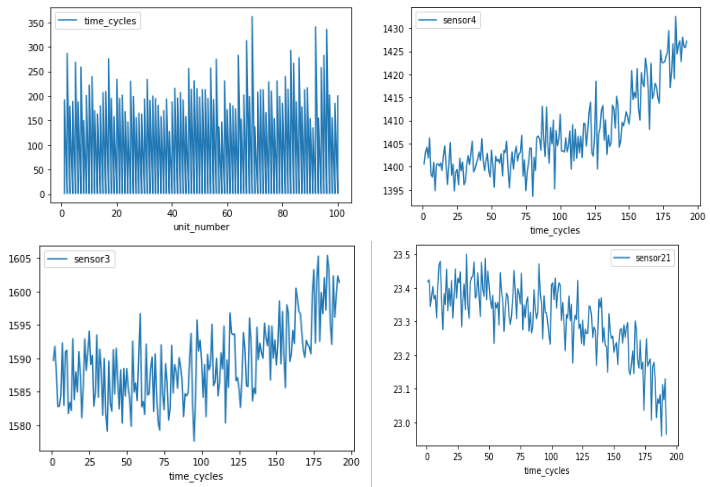
Data visualization of sensor readings from aircraft engines

I explored multiple deep learning architectures throughout the project. I started with a simple linear regression model and then moved on to experimenting with multilayer perceptrons, recurrent neural networks (RNNs), and long short-term memory (LSTM) networks.

The project was implemented in Python using TensorFlow and the Keras high-level API.

Need similar outcomes?

I can help assess your current architecture and scope a pragmatic implementation plan.

Related content

Discuss a similar project

Share your current setup and target outcome.

Prefer direct contact? Call +45 22 39 34 91 or email tb@tbcoding.dk.

Best for teams with architecture, reliability, security, or delivery risk in critical systems.

Typical response time: same business day.
Book a free 20-minute strategy call